
Of all the things a man has to dress for, a job interview remains one of the most stressful. You have seconds to make a first impression, but the psychology of attire is a double-edged sword.
Is a full suit too formal for a tech job? What does business casual actually mean in 2025? And what is the new standard for a Zoom interview, since what looks sharp in person can look unprofessional on a video call?
Dressing for an interview is a minefield. The old rule was “dress one step up”, but the new rule is “dress for the culture, with polish.” Showing up in a $2,000 suit to a startup can kill your first impression faster than a bad résumé.
This guide cuts through the confusion, providing the definitive 2025 playbook. We’ll help you decode the company culture and navigate every scenario with our 3-tiered system:
- Tier 1: Business Formal (The classic suit for law, finance)
- Tier 2: Business Casual (The new default for modern offices)
- Tier 3: Smart Casual (The startup & creative standard)
We also cover the new essentials: mastering the virtual interview, from shirts to setup, and finish with some grooming tips.


Why Trust Bespoke Unit for Suit Advice?
This guide is written and curated by our founder, Paul Anthony, an entrepreneur and recognized expert in men’s tailoring and styling. Unlike other guides, our advice is based on over 20 years of personal, hands-on experience in classic menswear and helping men develop a confident, personal style.
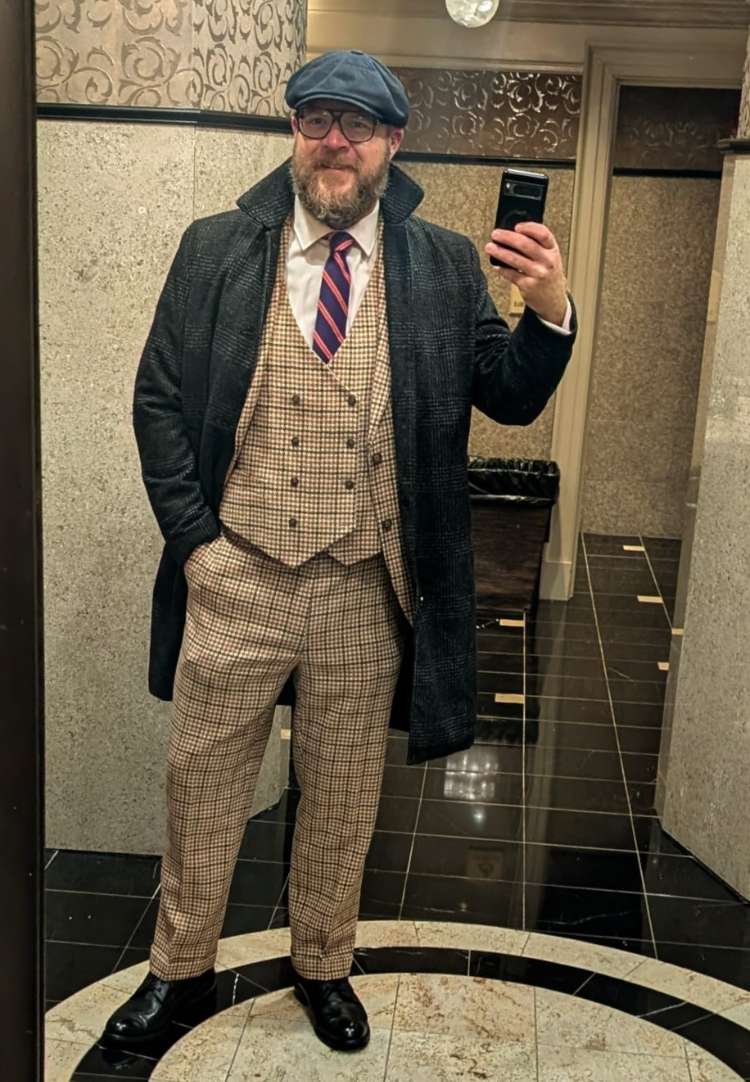
Paul founded Bespoke Unit in 2013 to provide the deep, well-organized content he felt was missing from the men’s style space. His insights are based on real-world experience, from understanding the fit for a “bigger guy” to personally owning dozens of suits and hundreds of pairs of dress shoes across the price spectrum.
Bespoke Unit is a leading independent publication in men’s style, specializing in tailoring, footwear, and grooming. Our recommendations are 100% editorially independent, so we only recommend products we have personally handled or would wear ourselves.
We never prioritize commissions over providing helpful and honest advice, but this article does contain affiliate links, which support our work at no cost to you.
Jump to Your Scenario
You can read this guide from start to finish or simply jump ahead to the section that most interests you by clicking one of the links below:

What to Wear to an Interview in 2025: A 3-Tiered Approach
How to dress for an interview now depends entirely on the industry. We’ve broken it down into three distinct tiers.
Tier 1: Business Formal (Finance, Law, Consulting, Medicine)
Business Professional or Business Formal is the scenario where the full, traditional suit remains the non-negotiable uniform. The goal is to convey authority, professionalism, and a keen sense of style. For this tier, the classic rules apply.
First, let’s build the complete outfit.
The Suit
Ideally, your suit should be either navy blue or charcoal grey. It’s often believed that black suits are suitable for professional situations, but this is a misconception.

Meanwhile, charcoal or navy gives off the air of reliability, credibility, and trustworthiness. This is what you want a potential employer to feel when he or she looks at you for the first time.
You’ll likely need to follow business professional guidelines, so try to avoid overusing patterns and details, such as ticket pockets or peak lapels. Therefore, the suit should have notched lapels and straight flap pockets.

Opt for Notch Lapels (Left)
The Shirt
Choose either a white or light blue shirt, ideally in a solid color.

Certain subtle patterns are suitable for the office, but they may be distracting during the interview itself. That said, you can wear different weaves, such as a fine twill or herringbone.
Similarly, opt for a classic spread collar and ensure it isn’t button-down. Additionally, we tend to lean towards barrel cuffs for your interview.
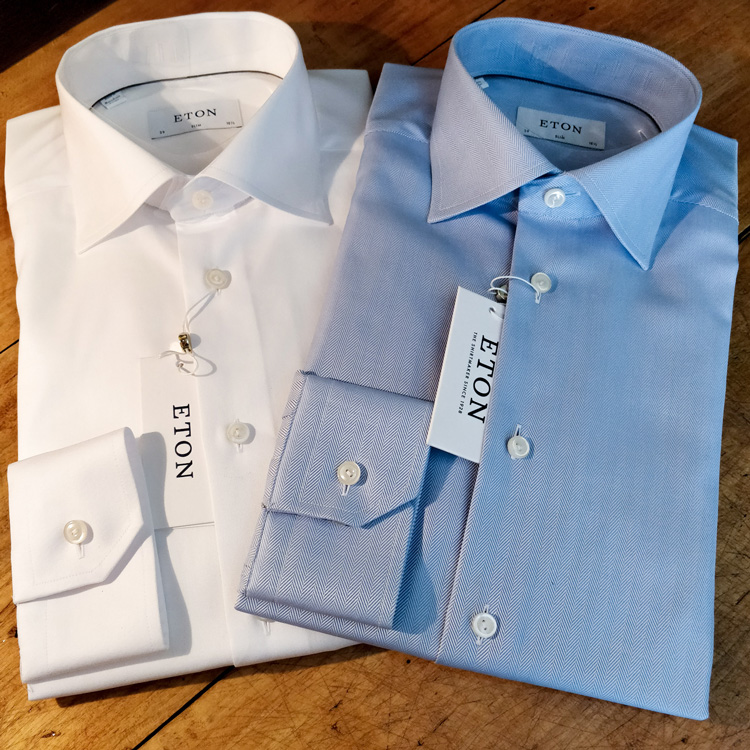
For some executive positions, a double “French” cuff would be fine. However, for junior positions, it might deliver the wrong message. For this reason, we suggest playing it safe and sticking to barrel cuffs.
The Shoes
Black or very dark brown leather cap-toe oxfords are going to be your best bet, as they’re the dressiest options you have at your disposal. Ensure they’re polished and otherwise in a presentable condition.

One of the best ways to gauge someone’s attention to detail is to examine their shoes. Should they be scuffed and in poor shape, that doesn’t speak well for you.
Tier 1 Recommendations: Where to Get The Look
Now that you have the formula, here are our specific brand recommendations for building this outfit.
Suits: SuitSupply vs. Indochino
For a Tier 1 interview, your suit is an investment. The two most popular brands for a first suit are SuitSupply and Indochino.
| Feature | SuitSupply (Ready-to-Wear) | Indochino (Made-to-Measure) |
|---|---|---|
| Best For | Modern European-style suits bought in-store | Full customization & hard-to-fit body types |
| Price Point | Starts ~$650 | Starts ~$450 |
| Construction | Half-canvassed, premium feel | Half-canvassed, variable quality |
| Timeline | Walk out same day (with alterations) | 4-6 week wait (or longer) |
| Verdict & Link | Opt for SuitSupply if your interview is soon and you want a reliable, high-quality modern fit. | Opt for Indochino if you have 6+ weeks and struggle to find suits that fit your build and/or preferred look. |

Indochino Made-to-Measure Suit
Our guide to business professional wear features a breakdown of the best brands, but our favorite value custom suitmaker is Indochino.
While made-to-measure suits sound expensive, Indochino has successfully made it an excellent investment that offers unparalleled value for money.
Shirts: Charles Tyrwhitt & Eton
For shirts, we recommend Charles Tyrwhitt (for its non-iron functionality and value) or Eton (as a premium option with a distinctive feel).
Finding quality barrel cuff shirts can be challenging, as most reputable brands will favor double cuffs. Once more, here we recommend Eton Shirts, a heritage Swedish brand.

Taking the Scandinavian minimalist route, their shirts all feature barrel cuffs with only a few subtle, albeit elegant details. They’re the perfect choice for a job interview and offer an excellent investment for your professional wardrobe
Shoes: Beckett Simonon & Allen Edmonds
If you need new shoes, we can recommend two brands that we currently love.
Firstly, Beckett Simonon is an excellent brand that offers superb value for money.

Their cap-toe Oxfords are crafted from Argentine calfskin and feature a Blake stitch construction.
The best part is that they come down to $203 when you use our unique code “BU20”. Considering this, the only downside is that they’re made to order and can take several weeks to be delivered.

Allen Edmonds Park Avenue Oxfords
Alternatively, we suggest the Allen Edmonds Park Avenue if you’re partial to American heritage shoes.
They’re more expensive, but if you plan on spending the next 5+ years in a formal office, these will be there with you every step of the way and require minimal maintenance.
Tier 2: Business Casual (Tech, Marketing, Modern Offices)
This is the new default for the modern workplace. A full suit is often out of place here. Instead, the goal is well-coordinated separates.
The ideal outfit is a tailored unstructured blazer or sport coat, paired with well-fitted chinos (or dress trousers) and a button-down shirt.

Fitting for a linen unstructured sports coat
The Business Casual Interview Formula
-
The Blazer: The key is an “unstructured” design. This style has less padding and provides a relaxed, modern look that is perfect for office wear without looking as formal as a suit jacket.
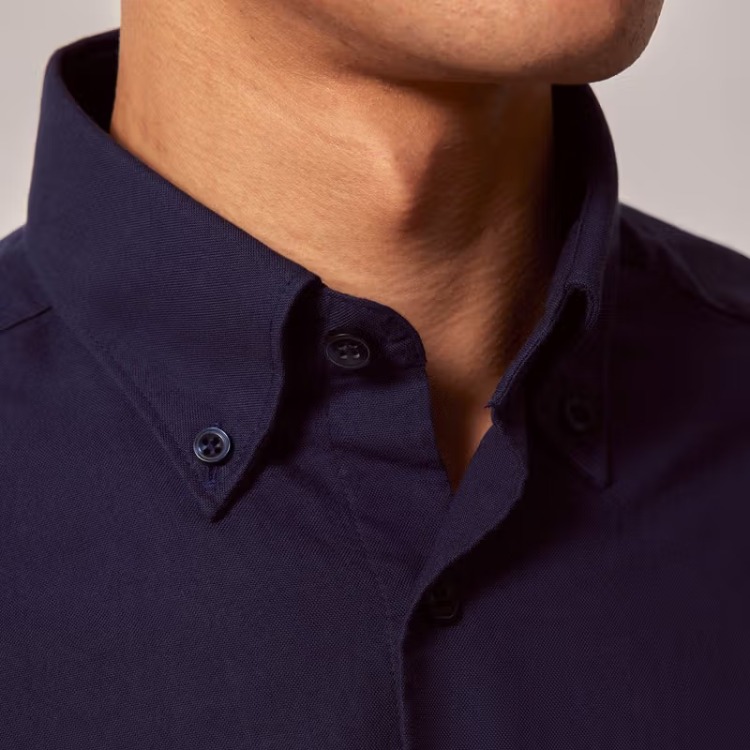
- The Shirt: An Oxford Cloth Button-Down (OCBD) is the perfect bridge between formal and casual. It’s a classic for a reason. A tie is typically optional or not worn at all.
- The Pants: This is a key component. Well-fitted chinos, khakis, or dress slacks are the standard. Unlike Tier 1, you should avoid wearing suit trousers.

Tier 2 Recommendations: Building Your Business Casual Outfit
Best Blazers
Our top recommendations for a business casual blazer are the Bonobos Jetsetter Unconstructed Wool Blazer or a Hockerty made-to-measure unstructured blazer.
Paul Wearing a Navy Blue Benson & Clegg Blazer
Best Shirts (OCBD)
Top recommendations for the Oxford Cloth Button-Down shirt include Hawkes & Curtis (best quality), Bonobos (best overall), and Uniqlo (best budget).
Best Chinos
This is a key component, and we recommend the top-tier “smart casual” pants that dominate the modern office:
| Brand/Model | Best For | Fabric/Feel | Price | Shop |
|---|---|---|---|---|
| Lululemon ABC Classic-Fit | Ultimate Comfort & Performance | Technical “Warpstreme” fabric, 5-pocket style. | $$$ | Lululemon |
| Bonobos Chino 2.0 | The Perfect Office Fit | Stretch-washed cotton, huge range of fit options. | $$ | Bonobos |
| J.Crew Chinos | A Slim, Modern Look | Stretch chino twill. | $$ | Jcrew.com |
Tier 3: Smart Casual (Startup, Creative, Media)
In these environments, the goal is to show personality and culture fit. A full suit is a significant mistake and can make you seem out of touch.
The goal is to look polished, but not formal. You have two excellent modern options:
- Option A (The Modern Twist): An unstructured suit (in navy or beige) paired with a crisp white or black T-shirt.
- Option B (The Relaxed Professional): A high-quality, premium polo shirt paired with smart chinos.

Smart Casual Recommendations
Here are the key items to build your Tier 3 outfit.
Best High-Quality Polo
A premium polo signals you understand quality without being stuffy.
We recommend Sunspel (famous as the ‘James Bond’ polo, conveying understated style), the Bonobos Piqué Polo (rated “Best for Work”), or a knit polo from Reiss.
Shoes for Smart Casual
For smart casual footwear, the modern dress sneaker has become the new standard, perfectly bridging the gap between athletic comfort and formal elegance.

Unlike athletic shoes, these are characterized by premium materials, such as Italian leather, minimalist designs devoid of flashy logos, and high-end construction.
Our detailed guide to the best dress sneakers covers the key styles to consider, from minimalist options like the Grant Stone Coast Sneakers to comfort-focused hybrids from Amberjack.

Mastering the Virtual Interview (Zoom, Teams)
This is a critical, high-intent section for the modern remote workforce. Your strategy here is “waist-up,” and it’s as much about your tech as it is about your attire.
1. Clothing for the Camera: What to Wear (and Avoid)

Herringbone Pattern (avoid on Zoom)
The ideal virtual/Zoom interview outfit is a simple, light-colored shirt with a neat sweater or a well-fitted blazer.
CRITICAL: What NOT to Wear on Camera
- Avoid intricate patterns like herringbone or small checks. These “shimmer” or create a distracting moiré effect on camera.
- Avoid bright white or pure black shirts. Bright whites can blow out the camera’s exposure, while black can make you look like a “floating head”. Solid, light-colored shirts like pale blue or gray are the safest bet.
2. Technical Setup for a Professional Look
The following technical considerations add immense “helpful” value and show you’re fully prepared for the job.
- Lighting: Good lighting is essential. Always face your primary light source (e.g., a window) or set up lights facing you from behind the screen.
- Camera Angle: Position the camera at or slightly above eye level. If you’re using a laptop, this means raising it so that it doesn’t appear as if you’re leaning over your keyboard at a café.
- Background: Ensure your background is clean, professional, and non-distracting.
3. Virtual Interview Shirt & Sweater Recommendations
When it comes to shirts, comfort is key for a high-stress situation.
Our top pick is a Savile Row Co. Navy Cotton Jersey Shirt, which feels similar to a T-shirt but looks just like a dress shirt. If you prefer a more traditional look, the Charles Tyrwhitt Non-Iron Royal Oxford is a reliable and crisp professional option.
For an additional layer of professionalism, consider a thin V-neck or crewneck sweater. V-necks are generally preferred for layering as they neatly frame a collared shirt.
Our top recommendations are the Polo Ralph Lauren Cable-Knit Cotton Sweater (best overall) or the Naadam The Original Cashmere Sweater (best lightweight luxury).
The Foundation: Building the Classic Interview Wardrobe
For those in Tier 1 or who have confirmed a Business Professional dress code, these are the fundamental components to master.
Choose Your Accessories Wisely
You should wear a tie, pocket square, belt, and socks. If you wear jewellery, keep it to a simple dress watch and a wedding band, if applicable.

Your Tie
Your tie should be subtle yet elegant. Red, blue, or yellow are good colors, but you can opt for anything that’s relatively conventional. However, avoid loud colours on this occasion.

Overall, you have the most leeway with blue in terms of shade, but keep the red and yellow tones relatively muted. As for patterns, basic stripes or pins are fine.
If you think it might help, a university tie could be fine. Bear in mind, though, they will have read your résumé and might not appreciate the reminder.
Pocket Square
In a job interview setting, your pocket square should be white and simply folded into a TV fold. Show just about a half inch in a straight horizontal line above the breast pocket.

Aim for a conservative pocket square fold (left), avoid puffy (right)
Avoid puffy or elaborate folds, as they can be quite distracting and may be perceived as too flashy. Similarly, bright colours and extravagant patterns may come off as too garish.
Your Belt
 Belts should be simple and match your shoes in terms of color.
Brown belts don’t have to be the exact same shade of brown as your shoes, but they should be reasonably close.
Conversely, try to avoid braces for a job interview. You might be able to wear them later, but they could give the wrong impression on this occasion.
What Socks To Wear
The basic rule of thumb is that socks should match your trousers.
When you’re out on a date, feel free to eschew this rule in favour of something more fun, but in a job interview, grey pants get grey socks and navy pants get navy socks.
To avoid showing a bit of leg hair when you cross your legs, we suggest over-the-calf socks. These go high and also grip the calf to prevent them from falling down. After all, rumpled socks are an untidy look.

Boardroom Socks is a great family business that specializes in these. They’re American-made from Merino wool in the James mill in North Carolina. Additionally, they start around $19.50 a pair, which is an excellent value given that they’re a heritage US brand.
Where To Buy Your Accessories
There are numerous menswear haberdasheries where you can find high-quality accessories.
In fact, most Jermyn Street shirt brands, such as Hawes & Curtis, often retail a wide variety of belts, ties, pocket squares, and cufflinks.

If you’re on a budget, we highly recommend checking out The Tie Bar. They’re quite well-known thanks to their reputation for stocking a rich yet affordable selection of accessories for men. If you need it, they probably stock it!
Furthermore, their site is well-designed and allows you to coordinate the different items in your shopping cart, making the task quite convenient as well. It’s a great destination for those starting out in the professional world.
How To Groom For A Job Interview
First, the basics: shower and brush your teeth the morning of your interview. You should be doing this regularly already, but a reminder never hurts.
 Second, see our guide to grooming. It will answer any questions you have regarding hairstyles, beards, and moustaches. It will also answer many questions you didn’t even know you had.
For job interviews, you want to present a clean, tidy appearance. Get a haircut about a week beforehand so that it looks neat but natural at the interview.
If you keep facial hair, groom it the night before or the morning of, depending on the rate at which your beard grows. Do not wear stubble to an interview. Either have a well-kept beard or be completely clean-shaven.
Be careful not to over-apply cologne. In fact, you should actually underapply it, as you want to keep your scent as subtle as possible.

Our guide to applying fragrances has a section dedicated to the office, which you can use as a reference. Additionally, we have another one detailing the best office fragrances that you could wear.
Pitfalls To Avoid in Interviews
Take a look at the picture below. Looks like a nice young man who’s gotten properly dressed for a job interview, right?

We admit that he did a halfway decent job. But that’s only halfway.
Let’s take a look at the errors he made so that you don’t make the same ones. We’ll start from the top:
Grooming: His hair is reasonably neat, but the stubble looks unkempt. While this may look fine at brunch after a bender, it’s a killer in a job interview. Either maintain a well-kept beard or shave that morning.
Shirt collar: It’s not resting properly underneath the jacket as it should. Details matter!
Peak lapels: Though the ones pictured above are relatively inoffensive, it’s best to avoid wearing peak lapels to a job interview, especially in the United States. Fancy as they are, they will be more of a distraction during an interview than anything else.
Tie knot: The knot is big and bulky and lacks a dimple underneath it. A four-in-hand or half-Windsor is a perfectly good knot for job interviews, but it should taper towards the bottom of the knot.
Interview Attire At a Glance: What to Wear
| Industry/Formality | The Go-To Outfit | Key Brands to Consider | Paul’s Pro Tip |
|---|---|---|---|
| Tier 1: Formal (Finance, Law) |
Two-Piece Suit (Navy/Charcoal) |
SuitSupply, Indochino, Bonobos | “Fit is everything. A $400 suit with $100 in tailoring looks better than a $1,000 suit off the rack.” |
| Tier 2: Business Casual (Tech, Marketing) |
Unstructured Blazer + Smart Chinos |
Bonobos, J.Crew, Lululemon | “Don’t ‘match’ your blazer and pants. Complementary colors (e.g., navy blazer, grey chinos) show far more style.” |
| Tier 3: Smart Casual (Startup, Creative) |
Premium Polo + Chinos OR Unstructured Suit + Tee |
Sunspel, Reiss, Asket | “This is about ‘culture fit.’ Look at their ‘About Us’ page. Your goal is to look like their sharpest employee.” |
| Tier 4: Video/Zoom (Any Remote) |
Solid Color Shirt + Optional Sweater |
Charles Tyrwhitt, Naadam, Savile Row Co. | “Avoid small, busy patterns. Solid colors (light blue, navy) look crisp and professional on camera.” |
In Conclusion
The point of dressing for an interview is not to look good so much as to demonstrate that you understand professional sartorial mores.
Furthermore, dressing the right way will allow the interviewer to focus on you, your achievements, your personality, and what you can bring to the table for their organization.
To learn more about suits and other sartorial information, visit our Suits Homepage.
What Next?
Now that you have read our primer on dressing for a job interview, consider reading some of our related content:


About The Author – Paul Anthony
 Paul is a the founder and creative director of Bespoke Unit. His interests range from: suits, shoes, watches, sport, and travel. See his full profile here, and read latest articles.
I dissent for one main reason: The best way to be get a job is to be the best qualified, and then to be the most remembered. To that effect, wearing “wrong” clothes is perfectly acceptable because it makes one stand out.
I’m not suggesting one wear something as ostentatious as Colin Baker’s Sixth Doctor in Doctor Who, but it is a fact that looking a bit like a cartoon character is the best way to be remembered, hands down.
Finally, I will dress nicely and properly for any interview, but I will wear well-worn red Converse high-tops. A job interview is a two-way thing. I am also interviewing the company. Any job that would not hire be because I wear my Chucks is a job I do not want anyway.
Hi Dodger,
Me too but in most conservative professional environments, that’s a huge risk and doesn’t always leave the right sort of memorable impression. For instance, before I joined Bespoke Unit, I used to work in film production. Since everyone was in jeans and a t-shirt, I’d go with light-coloured suits, Ascots tied into cravat knots, and lapel flowers.
This often worked but if I rolled up for an interview on Wall Street dressed like that, I’d be laughed out of the office. I think it’s mostly a question of knowing your audience.
Best,
CP
Further to your noting that the dress code will depend on your audience: wearing an ‘office suit’ for an interview for the types of jobs I’ve worked (mostly construction, with the occasional warehouse job when there’s a lull in house-building) would create just as bad an impression as rocking up to an interview for an office job in jeans and a t-shirt would.
My advice on dressing for interviews for blue-collar jobs would be to go with business casual. Jeans and a t-shirt (underneath all your usual PPE, of course) are fine for when you’ve got the job, but won’t give the best of first impressions for the actual interview. On the other hand, you’d be rather overdressed if you wore the kind of suit described in this article. I think business casual strikes the right balance. Would you agree with this, CP? Or do you think business professional is too casual to ever wear to an interview, even for a manual labour gig?
Hi Steve,
I see what you mean and typically business casual tends to be the what people wear for interviews in construction and other labour professions. On a similar note, I worked in the film production industry before I joined Bespoke Unit. Although everyone wore jeans and trainers, I wore suits and also worked wearing a suit. It raised a lot of eyebrows but it left a solid impression and I always received positive comments.
While you can wear business casual for a job interview for more blue-collar trades, I don’t think a suit would hurt you. In fact, it may even work to your advantage by helping you stand out from the crowd as somebody to be taken seriously.
All the best,
CP
Thanks for mentioning wearing a charcoal or navy suit since you can look reliable and credible. I have a job interview next week for a better position for a new firm and I’m stressed about being prepared. I’ll be sure to find a nice suit that I can wear to impress the potential employer.
Hi Taylor,
I hope that our guide has helped!
All the best,
CP
In your newsletter photo, your collar is not underneath the jacket. Details matter!
Which newsletter photo is that? I’ve looked back at all of them since mid-January and in all those that I’ve seen where staff is wearing a suit, the collar is neatly tucked under the jacket!
I think he means when you click on your name, but the collar is tucked under the jacket. The collar, of the shirt, is partly tucked into the best on one side and not tucked on the other, and I believe this is what the other guy is referencing. I use this article as a guide so I think you look dapper .